
The peptide capacity race: Who is building, where, and how fast?
Who is investing?
The global peptide manufacturing map is being redrawn. Pharmaceutical giants are investing heavily in their own production networks, while specialist contract manufacturers are expanding to capture demand from a rapidly growing market. Some are adding capacity to existing sites; others are building entirely new manufacturing complexes.
The scale is striking. Eli Lilly has committed $9 billion to its API manufacturing site in Lebanon, Indiana, while Novo Nordisk's Kalundborg expansion carries a DKK 49.6 billion (approximately $7.4 billion) investment figure. Contract development and manufacturing organizations (CDMOs) are also making major investments, with several announcing thousands of liters of additional synthesis capacity.
Major expansion examples across the peptide supply chain, 2026–2030
| Company / location | Investment or capacity | Timing |
|---|---|---|
|
Eli Lilly
Lebanon, US
|
$9bn API investment | 2027 target |
|
Novo Nordisk
Kalundborg, Denmark
|
DKK 49.6bn (~$7.4bn) | 2029 target |
|
WuXi STA
China / Singapore
|
>130,000 L SPPS, company-wide target | Target date not confirmed |
|
Asymchem
China
|
>45,000 L commissioned; ~69,000 L targeted | 2026 |
|
Neuland
India
|
7,000 L combined SPPS/LPPS | Operational 2026 |
|
CordenPharma
Colorado, US
|
>42,000 L SPPS site target | 2028 |
|
Bachem
Sisslerfeld, Switzerland
|
>CHF 500m investment | 2030 target |
Source: Company disclosures and TideMetrix Capacity Tracker. Investment figures, reactor volumes and company-wide targets are not directly comparable. US-dollar equivalents are approximate and should be treated as illustrative rather than fixed exchange-rate conversions.
How quickly will it hit the market?
The investment announcements tell only part of the story. A new factory can take years to build, commission and validate, and even an operational facility may need additional time to reach commercial-scale output.
The industry's expansion will arrive in waves. Some manufacturers are already ramping up production, while others won't be ready until the end of the decade. For raw-material suppliers, that creates a difficult balancing act: invest too early and risk excess capacity, or wait too long and miss the opportunity to secure customers.
There's also a distinction between capacity being built and capacity available to the market. Eli Lilly and Novo Nordisk are expanding primarily to supply their own medicines, while CDMOs such as Bachem, CordenPharma and WuXi STA manufacture for pharmaceutical customers. Even CDMO capacity may be committed under long-term agreements before a facility opens.

Selected project milestones from the TideMetrix Capacity Tracker. Reported achievements and future company targets are distinguished. Horizontal bars indicate milestone timing, not construction duration. Source: Company disclosures; TideMetrix Capacity Tracker, approved October 2026.
For more information, see the TideMetrix Capacity Tracker.
What does it mean for raw materials markets?
The raw-material bill is bigger than you might think
Building a peptide factory is expensive. Keeping it supplied is another challenge altogether. Every production run requires amino-acid building blocks, synthesis resins, coupling reagents and large quantities of solvents — and the cost of those materials can add up quickly.
An analysis by Novo Nordisk researchers offers a revealing glimpse into where the money goes. In one solid-phase peptide synthesis (SPPS) campaign, solvents accounted for 27% of raw-material costs, coupling reagents for 23% and resins for 15%. Together, those three categories represented 65% of the material bill.
The remaining 35% covered amino-acid building blocks and other reagents, including three nonstandard amino-acid derivatives that alone accounted for 16 percentage points of the total.
These figures reflect one clinical peptide synthesis campaign, not an industry-wide average, but they highlight an important point: protected amino acids are only part of the story. Solvents, reagents and resins also represent major cost components.
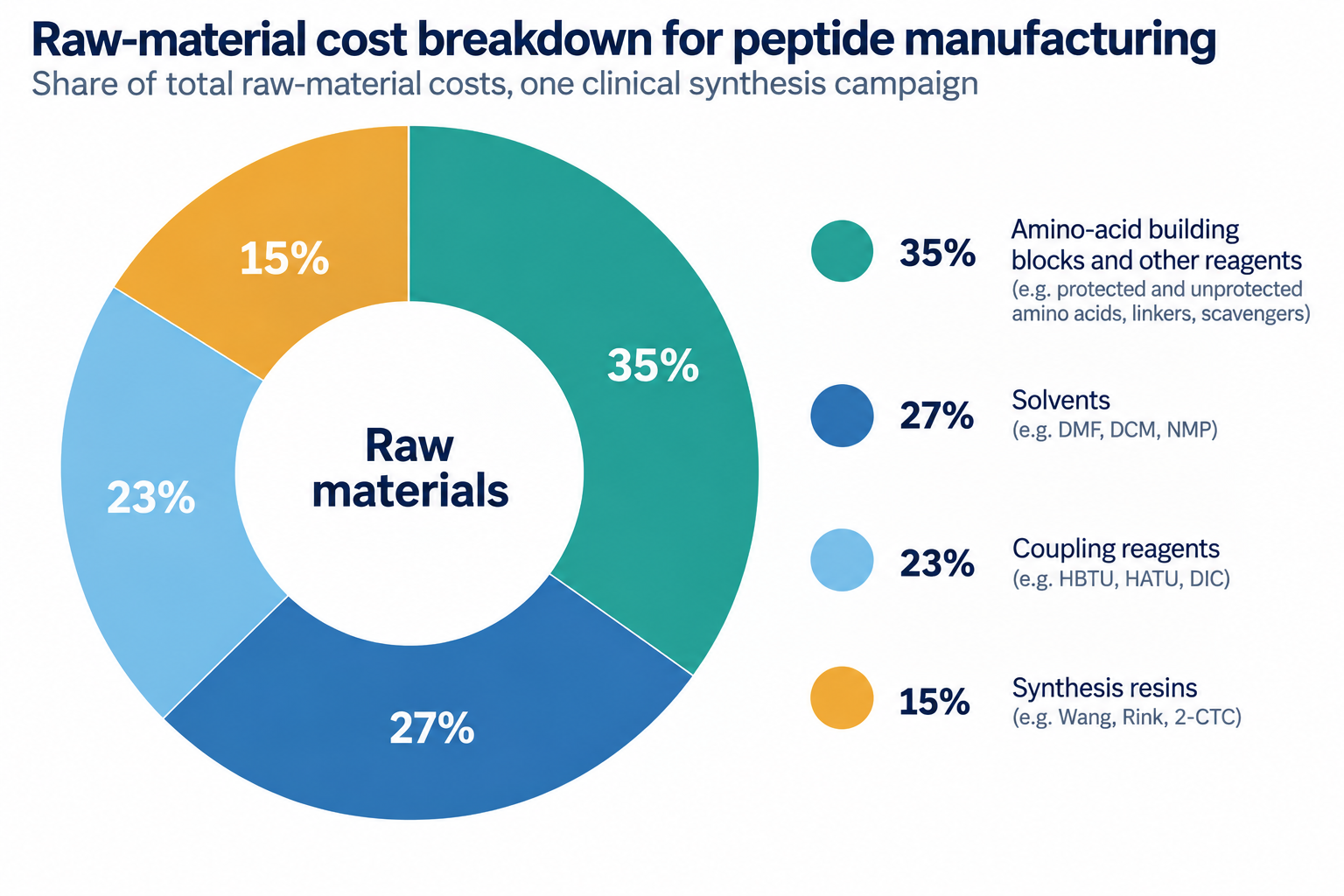
Illustrative breakdown of raw-material expenditure in a clinical peptide synthesis campaign described by researchers from Novo Nordisk. Source: “Greening the synthesis of peptide therapeutics: an industrial perspective,” RSC Advances (2020). Figures reflect a single manufacturing campaign, not an industry-wide average.
More capacity, more demand — but not necessarily in proportion
The wave of new peptide manufacturing capacity promises a substantial increase in demand for raw materials. But the relationship is far from straightforward. Doubling synthesis capacity doesn't necessarily mean doubling purchases of protected amino acids, resins, reagents or solvents.
Longer and more complex peptides require different quantities and combinations of building blocks, while production yields, synthesis methods and batch sizes can dramatically change material consumption. Reactor volume alone tells us relatively little about how much of any particular raw material a factory will need.
Manufacturers are also working to make synthesis more efficient. Solvent recovery and recycling, improved coupling chemistry and alternative production methods could reduce material consumption per kilogram of finished peptide, even as total output increases.
Solvents and synthesis resins present their own supply-chain risks. Acetonitrile has a history of severe shortages and price spikes, while the enormous solvent requirements of SPPS are encouraging manufacturers to invest in recovery and recycling. Specialized synthesis resins could become another constraint as new facilities ramp up, particularly where customers require consistent, qualified material at commercial scale.
For suppliers, the capacity boom is both an opportunity and a forecasting challenge. Demand will depend not just on how much peptide is produced, but on what is being manufactured, how efficiently and with which materials.
The vertical integration question: Who gets the business?
Some peptide manufacturers are moving upstream, producing critical raw materials themselves rather than relying entirely on outside suppliers.
Bachem manufactures amino-acid derivatives, CordenPharma integrates production of selected starting materials and peptide side chains, and China's Sinopep produces specialized noncanonical amino acids in-house. CordenPharma's supply-chain relationships also extend to coupling reagents.
The trend is most evident in specialized amino-acid derivatives and building blocks, rather than solvents or synthesis resins. For independent suppliers, that distinction matters: the capacity boom could generate very different commercial opportunities across raw-material categories.
Vertical integration won't eliminate external purchasing, but it could reshape who supplies what — and how much of the resulting demand reaches the merchant market.
The next race is upstream
Raw-material suppliers are expanding too. China's Highfine, for example, is developing new protected-amino-acid and coupling-reagent capacity at its Huai'an site, with trial production targeted for late 2026 to early 2027.
Yet adding capacity is only half the battle. Pharmaceutical customers demand consistent quality, traceability and reliable commercial-scale supply. Qualification can take time, while new peptide factories may ramp up years later than their initial announcements suggest.
For upstream producers, success will depend on investing in the right materials, securing customer approvals and scaling production at the right moment.
The peptide capacity race isn't just about who builds the biggest factories. It's about who supplies them — and how much of that business ever reaches the open market.
Sources:
Company announcements and regulatory disclosures from Eli Lilly, Novo Nordisk, WuXi STA, Asymchem, Neuland, CordenPharma, Bachem and other manufacturers; TideMetrix Capacity Tracker; Martin et al., RSC Advances (2020).